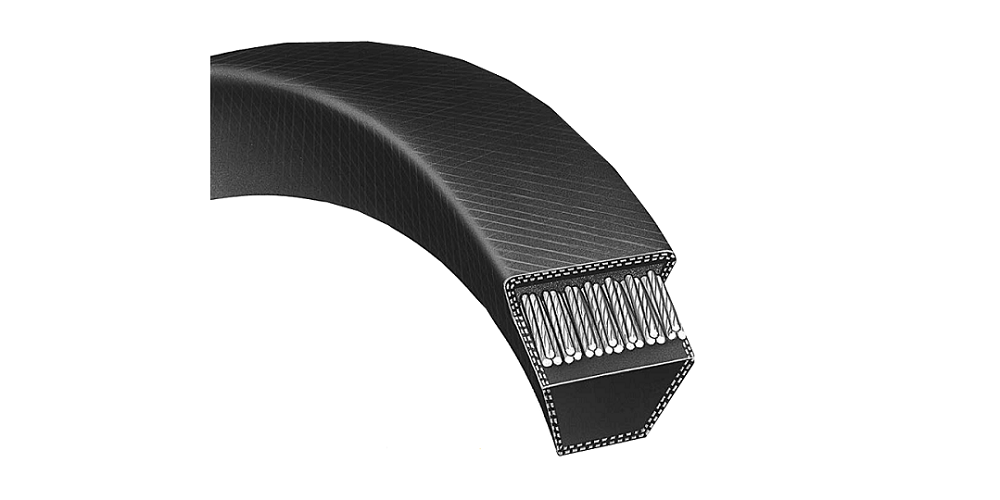
Types Of Synchronous Belt Profiles and Nomenclature

Image source: https://www.bandousa.com
A Synchronous belt, also known as a timing belt, resembles a flat belt with evenly spaced teeth perpendicular to the belt's axis.
The belt teeth are designed to mash with pulley teeth, similar to chains. Timing belts do not rely on friction to transmit torque; instead, they rely on the positive engagement of belt teeth with the teeth on the sprocket. This results in minimal relative movement between the belt and the sprocket. Timing belts should be used where exact synchronization between driver and driven shafts is required. Timing belts are also available in dual-sided configurations. Dual-sided timing belts have teeth on both sides of the belt.
The first synchronous belt drives were seen in the early 1940s. The tooth profile was a simple trapezoidal design. This design is still in use today. It is available in 6 standard pitches in the inch system. Below are the letter designations for these pitches.
-
MXL Mini Extra Light 0.080”
-
XL Extra Light 0.200”
-
L Light 0.375”
-
H Heavy 0.500”
-
XH Extra Heavy 0.875”
-
XXH Double Extra Heavy 1.250”

The part numbers for trapezoidal belts are written in the following format.
250XL050
250 means 25” in Length, XL 0.200” pitch, 0.50” wide.
Nowadays, three common synchronous belts are based on their curvilinear profiles: H-type, S-type, and R-type.
H-TYPE
The H-type tooth profile is referred to as HTD. It has a round tooth profile, and a group of radii defines its shape centered at a specific distance from the belt's pitch line.
It is available in 3mm, 5mm, 8mm, 14mm, and 20 mm pitches in various widths and lengths.

The part number typically has the format shown below.
540-H8M-20
540 means 540mm pitch length, H8M 8mm pitch, H-type tooth profile, 20 for 20mm belt width
A dual-sided version of this belt has the following part number:
540-DH8M-20
S-TYPE
The S-type tooth profile is referred to as STPD.
It is available in 3mm, 4,5mm, 5mm, 8mm, and 14mm pitches in various widths and lengths.

The part number typically has the format shown below.
80-S8M-380
80 means 8mm belt width, S8M stands for 8mm pitch, S-type tooth profile, and 380 is the pitch length in mm.
A dual-sided version of this belt has the following part number:
80DS8M380
Where ‘D’ indicates ‘dual-sided.’
R-TYPE
The R-type synchronous belt is an in-depth profile parabolic tooth design used in R-type.
It is available in 5mm, 8mm, 14mm, and 20mm pitches in various widths and lengths, in single-side and dual-side configurations.

The part number typically has the format shown below.
185-3M-20
One hundred eighty-five means 185mm pitch length, 3M stands for 3mm pitch, and 20 is belt width in mm.
A dual-sided version of this belt has the following part number:
D185-3M-20
The R-type is used in the automotive industry as cam timing drives, replacing chains.
Timing belts are much lighter than chains, require less maintenance, and do not need lubrication.
Also, have a look at our post The Common Types of V-Belts.
Feel free to Contact Us if you have any questions, need more information or if you are interested in purchasing a timing belt.
Check out our Timing-Belt selection.
Brands HVH offers Bando, Continental Contitech, and Mitsuboshi Belting.
Vladimir Harutyunyan
Vladimir Harutyunyan is the founder of HVH Industrial. He has masters degree in mechanical engineering and over 10 years of experience in mechanical power transmission field.
Feel free to connect with Vlad on Linkedin: https://www.linkedin.com/in/vladharut
Vladimir Harutyunyan
Vladimir Harutyunyan is the founder of HVH Industrial ...
Feel free to connect with Vlad on Linkedin: https://www.linkedin.com/in/vladharut